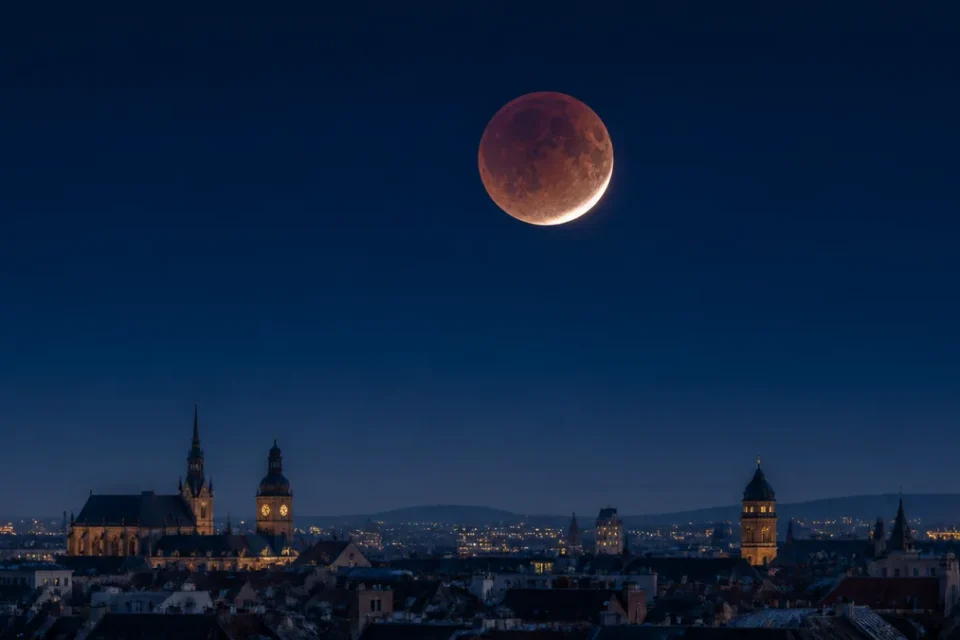
The August 2026 lunar eclipse peaks on August 28 at about 04:14 UTC, with roughly 93% of the Moon’s diameter entering Earth’s dark central shadow.
The deep partial eclipse begins on the evening of August 27 in much of North America and continues into August 28 in other time zones. It is visible from the Americas and parts of Europe and Africa, but local weather, moonset and horizon conditions decide how much any observer can see.
August 2026 lunar eclipse: key facts
- Greatest eclipse: about 04:14 UTC on August 28.
- Partial phase: approximately 02:35–05:53 UTC.
- US times at maximum: 12:14 a.m. EDT, 11:14 p.m. CDT, 10:14 p.m. MDT and 9:14 p.m. PDT.
- A lunar eclipse is safe to watch without eclipse glasses.
What makes this eclipse unusual?
A lunar eclipse happens when Earth moves between the Sun and the Moon and casts its shadow across the lunar surface. This one is partial rather than total, yet NASA’s catalog gives it an umbral magnitude of about 0.93. That means only a relatively narrow portion of the Moon remains outside the deepest shadow at maximum.
The eclipsed area may look dark gray, rusty or copper colored. Its exact appearance depends partly on Earth’s atmosphere. The bright uneclipsed edge creates a strong contrast, making the event easy to notice when skies are clear.
When should viewers look in North America?
Greatest eclipse occurs at about 04:14 UTC on August 28. That converts to 12:14 a.m. Eastern Daylight Time, 11:14 p.m. Central on August 27, 10:14 p.m. Mountain and 9:14 p.m. Pacific. The partial phase lasts more than three hours, so viewers do not need to arrive at the exact minute of maximum.
In Canada, use the corresponding local time zone. Western locations see the event earlier in the evening, while eastern locations observe it after midnight. Alaska, northern communities and remote areas should check a local astronomy calculator because moon altitude and twilight differ significantly.
What about the UK and western Europe?
In the UK, greatest eclipse is around 5:14 a.m. BST. The Moon will be low and dawn will already be developing, so an unobstructed western horizon matters. In parts of continental Europe the equivalent clock time is around 6:14 a.m. CEST, close to moonset in many cities.
Visibility on a global map does not mean every phase is visible from every location. Check moonset, twilight and the Moon’s altitude for your town. A hill, building or line of trees can hide an object that is only a few degrees above the horizon.
Is any eye protection required?
No. Lunar eclipses are safe to view with the unaided eye because observers are looking at sunlight reflected by the Moon, not directly at the Sun. Eclipse glasses designed for solar viewing are unnecessary and will make the scene much too dark.
Binoculars and telescopes can be used normally for the Moon. However, never point optical equipment at the Sun without a proper front-mounted solar filter during a solar event. Ordinary sunglasses and improvised filters are not safe for direct solar viewing.
How to photograph the eclipse
For a phone, use a stable support, turn off flash and lower exposure after tapping the Moon. Heavy digital zoom often produces a soft white circle rather than real detail. A camera with a telephoto lens, tripod and short self-timer gives more control. Bracket several exposures to preserve both the bright edge and the shadowed surface.
A foreground can provide scale, but plan the Moon’s direction before choosing a location. Keep away from roads and closed property, and do not sacrifice safety for a clear horizon. Cloud forecasts should be checked shortly before leaving.
How to verify livestreams and images
If clouds block the view, use a stream from NASA, an observatory, a university or a known astronomy organization. Be cautious of pages that require a browser extension, payment details or a cryptocurrency transfer to watch a public event.
When sharing images, check the date, location and photographer. Old total-lunar-eclipse photographs often circulate around a new event. This August eclipse is partial, so a perfectly uniform fully red Moon may not show the actual 2026 maximum.
Frequently asked questions
Is the August 2026 lunar eclipse total?
No. It is a deep partial eclipse, with about 93% of the Moon’s diameter inside the umbra at maximum.
Can I watch it without glasses?
Yes. No special eye protection is required for a lunar eclipse.
Why do some websites show August 27 and others August 28?
The eclipse crosses midnight in UTC and local dates differ. Much of North America sees the partial phase begin on August 27, while the UTC maximum is August 28.
Official sources
Checked on August 21, 2026. Verify local moonset, weather and horizon conditions before travelling.
Another August 27 event: when is the official GTA 6 extended look?