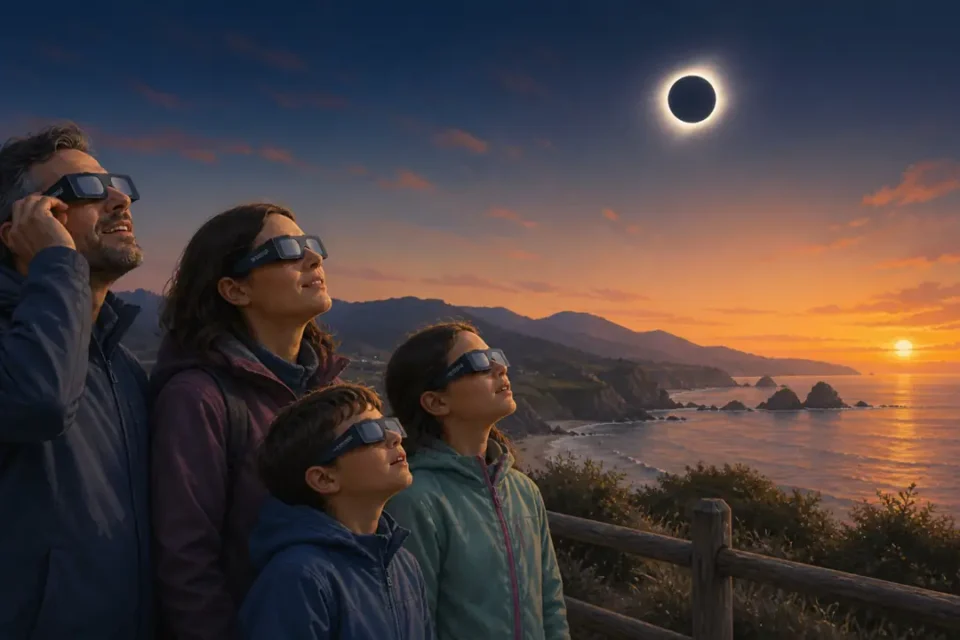
The August 12, 2026 solar eclipse will be total along a path that includes Greenland, Iceland and northern Spain. Much of Europe will instead see a partial eclipse. Check a city-specific map and time before travelling: a short distance can change the view, and the Sun will be low in the sky in several locations.
Where will it be total?
According to NASA, totality crosses Greenland, Iceland, part of the Atlantic, northern Spain, northern Russia and a small part of Portugal. A partial eclipse will be visible across large areas of Europe, North Africa, Canada and the northern United States.
Partial and total are not the same
During a partial eclipse, looking at the Sun without proper solar protection is never safe. Direct viewing is only possible during the short period of complete totality, when the bright solar surface is entirely covered. Put protection back on before any bright part of the Sun reappears.
What you need
- Intact, purpose-made eclipse glasses used according to their instructions.
- A dedicated solar filter for cameras, binoculars and telescopes.
- A backup plan to watch an official livestream if cloud, crowds or safety conditions prevent viewing.
Plan the day safely
Arrive early, choose an open location and keep your glasses within reach. Do not watch the sky while driving and supervise children. A smartphone photo without a solar filter does not protect eyes or the camera sensor.
Bottom line
This is a memorable event, but local information and eye safety come first. Maps, timing and official coverage are available from NASA.
Turn an alert into a practical decision
A useful warning identifies an area, time window, level and hazard. Check your address or route on the responsible authority’s map first. A national headline may be accurate without applying to your location. Then read the update time because a storm track, smoke plume, air-quality reading or intensity can change quickly.
Prepare one clear action before conditions worsen: charge the phone, identify solid shelter, secure outdoor objects and set aside water, necessary medicine and a way to receive alerts. For travel, check road status with the official operator rather than an isolated video.
During the event
- Follow local evacuation, shelter or window-closing instructions.
- Do not approach floodwater, fire, fallen power lines or a road hidden by dust.
- Help children, older people and anyone whose health depends on electricity, medication or cleaner air.
- Keep non-urgent calls short to preserve battery life and network capacity.
A mask, purifier, fan or air conditioner does not solve every hazard in the same way. Follow local health advice and never operate combustion equipment in an enclosed space.
After the warning
Wait for an official all-clear before returning to an evacuated area. Photograph damage without exposing yourself, check water and power before use, and report persistent hazards. When accounts conflict, prioritize the weather authority, civil-protection service, fire department or responsible health agency.
A five-minute check for “August 12, 2026 solar eclipse: where to see it and how to watch safely”
- Date: open the original notice and find its latest update, not only the date of a page summarizing it.
- Scope: confirm that the country, region, product, agreement or event really matches your situation.
- Decisive detail: record the lot, time, domain, rate, warning level or other reference that prevents an overly broad conclusion.
- Channel: take action through the official website or app opened independently.
- Evidence: keep the notice, receipt or useful screenshot with the consultation date.
Three common mistakes
The first is acting on a headline without reading the limits of the notice. The second is sharing a screenshot that has no date or source link, allowing it to circulate after a correction. The third is confusing general information with an individual instruction. Public guidance supports a decision, but the agreement, case, product or local warning remains the reference.
If two credible sources conflict, do not select the more dramatic one. Compare their update times and return to the organization with direct responsibility. Display an important correction clearly so readers who saw the earlier version understand what changed.
Key takeaway
Useful information should support a proportionate action: verify, prepare, contact or wait. It should not manufacture urgency. Take a few minutes to confirm the scope before paying, travelling, discarding a product or changing an agreement.