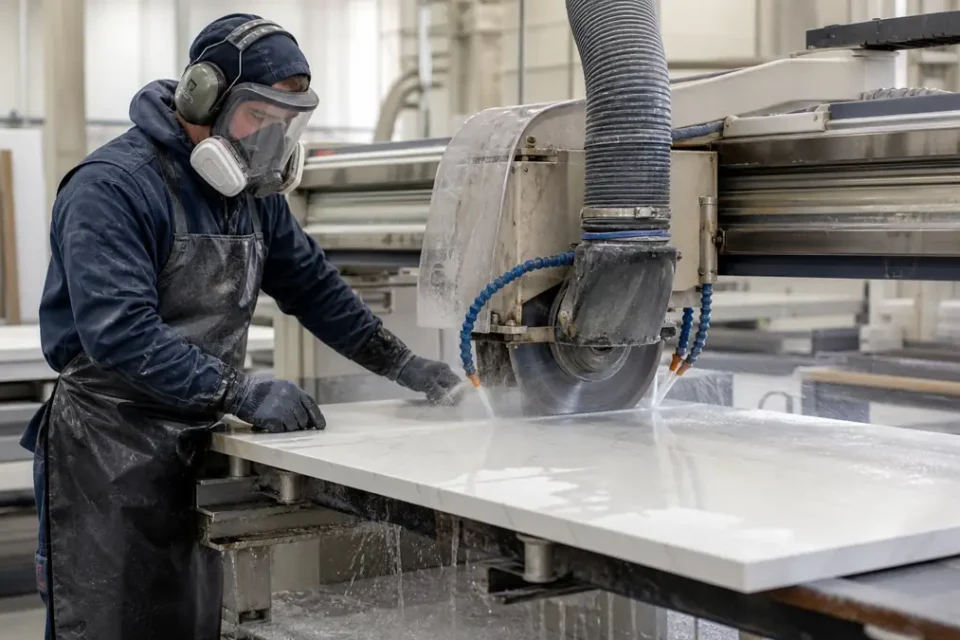
“California quartz countertop silicosis” is showing more than 2,000 rising searches in Google Trends. California health and workplace-safety agencies warn that cutting and finishing engineered stone can release respirable crystalline silica. Inhaling this dust can cause silicosis, a serious and irreversible lung disease.
Why are quartz countertops linked to silicosis?
Engineered stone, often marketed as quartz, can contain very high levels of crystalline silica. Cutting, grinding, drilling, sanding and polishing can create particles small enough to reach deep into the lungs. The finished countertop in a home is not the same exposure as dry fabrication dust in a workshop; workers performing or standing near fabrication tasks face the principal occupational risk.
What is silicosis?
Silicosis is lung scarring caused by inhaled crystalline silica. It can progress even after exposure stops and has no cure. Symptoms may include cough, shortness of breath, fatigue or chest discomfort, but workers can be affected before obvious symptoms appear. Similar symptoms have many causes, so diagnosis requires medical assessment and an occupational history.
How serious is the California problem?
A California Department of Industrial Relations fact sheet reported 519 California artificial-stone workers with silicosis from 2019 through February 2026, including 29 deaths and 55 lung transplants. Counts change as surveillance continues and should be read from the current state dashboard rather than repeated without a date.
Which tasks create high exposure?
- Dry cutting or grinding engineered stone.
- Drilling, polishing, chipping or shaping slabs.
- Cleaning dust with compressed air or dry sweeping.
- Handling dusty waste and contaminated surfaces.
- Working nearby without effective isolation and controls.
What protections does Cal/OSHA describe?
California requirements include effective wet methods, safe housekeeping, restrictions on unsafe practices, appropriate high-level respiratory protection, training and medical surveillance for covered workers. A respirator alone is not a substitute for engineering controls. Employers must evaluate the task and follow the applicable standard.
What should a current or former worker do?
Tell a healthcare professional about countertop fabrication work even if symptoms seem mild or absent. California guidance asks clinicians to consider silicosis in exposed workers and use appropriate imaging and lung-function evaluation. Seek urgent medical care for severe breathing difficulty, blue lips, confusion or other emergency symptoms.
Can homeowners diagnose the risk from a countertop?
No. Colour or brand does not reveal occupational exposure, and an installed surface should not be cut or ground without competent controls. Homeowners planning alterations should hire qualified professionals and ask how dust will be contained, rather than attempting dry cutting indoors.
Official information
Use the California Department of Public Health worker guidance and Cal/OSHA silica resources. This article provides general information, not a diagnosis or treatment plan.
Related question: How should a health alert be interpreted without overstating personal risk?
What medical surveillance may include
California guidance for covered silica-exposed workers describes occupational and clinical history, lung-function testing, tuberculosis testing and appropriate chest imaging. The exact examination is a clinical decision. Workers should bring the safety data sheet when available and clearly describe every cutting, grinding and cleanup task.
What rights should workers ask about?
Workers can ask for training, exposure-control procedures, respiratory protection and medical-surveillance information in a language they understand. Immigration status does not make silica dust safe. California resources include worker-rights and compensation information; a qualified adviser can explain an individual claim.