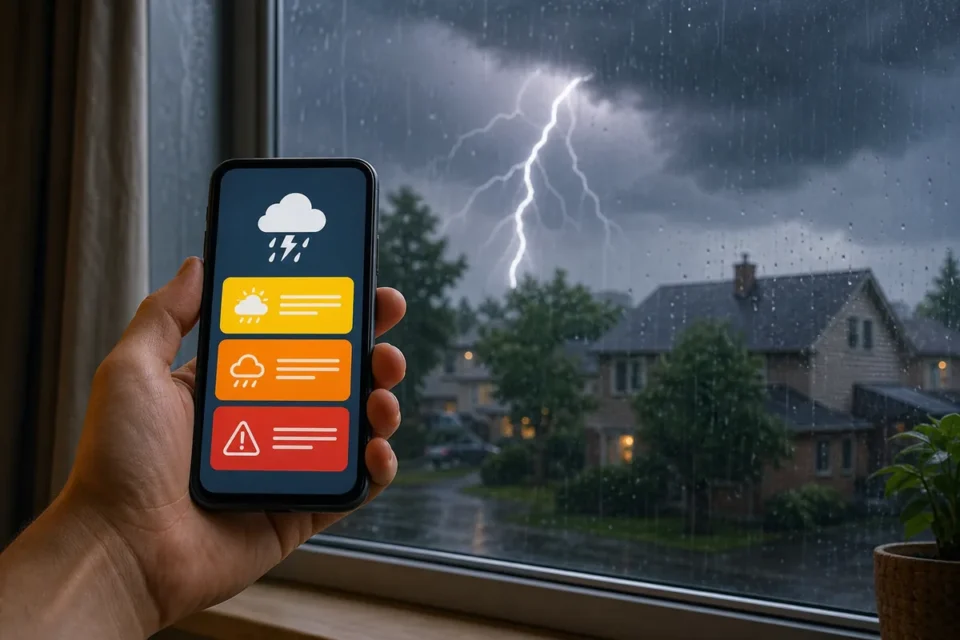
A Canadian weather alert now combines a message type — warning, advisory or watch — with a yellow, orange or red colour. The type mainly tells you how urgently to act and how close the hazard may be. The colour summarizes expected impact severity. Always read the full alert because two messages with the same colour may describe very different threats.
Warning, advisory and watch compared
- Warning: act now because severe weather is occurring or expected, often within 6 to 24 hours. Tornado warnings may arrive with less than thirty minutes’ notice.
- Advisory: act to protect yourself from significant but generally less severe events such as fog, freezing drizzle, frost or blowing snow.
- Watch: get ready because conditions favour severe weather, although the exact location or occurrence is not yet certain. It may be upgraded to a warning.
What do yellow, orange and red mean?
The colour communicates impact level: yellow indicates moderate effects, orange high impacts and red extreme consequences. It is not enough on its own. Check the affected area, start and end time, forecast confidence, likely effects such as power outages or dangerous travel, and the recommended actions.
Are WeatherCAN and Alert Ready the same?
No. WeatherCAN provides forecasts and local alert notifications. Alert Ready is the national emergency system that can interrupt broadcasts and send critical notifications to compatible phones. For weather, Environment and Climate Change Canada uses Alert Ready for tornado warnings and certain exceptionally severe thunderstorm warnings, among specific hazards.
What should you do during a tornado warning?
Move immediately into a sturdy building, preferably a basement or a small interior room on the lowest floor. Stay away from windows, protect your head and do not delay to record video. If you are in a vehicle or mobile home, follow local instructions and reach a substantial shelter when that can be done without increasing exposure.
Alert-readiness checklist
- Enable WeatherCAN notifications for your location.
- Check that the phone supports Alert Ready.
- Keep a radio, power bank and flashlight accessible.
- Add locations where close relatives live when the app supports it.
- After a notification, read the current update rather than relying on an old screenshot.
Is a Special Weather Statement an alert?
No. It gives extra information about unusual or potentially concerning conditions but is not a warning, advisory or watch and is not colour-coded.
Sources officielles : Government of Canada weather alerts and tornado preparedness.
How should you read Canada’s Air Quality Health Index during wildfire smoke?
Why can an alert change quickly?
Meteorologists continually reassess a hazard’s track, intensity and observed impacts. A watch may be cancelled when the threat fails to develop or upgraded when confidence increases. The affected area can also shrink or shift. Always check the issue time and newest official version. A social-media screenshot may remain in circulation after the authoritative alert has changed.
What if phone alerts do not arrive?
Do not rely on one channel. Confirm notification and location settings, update the operating system and WeatherCAN app, and check the official weather map directly. Keep access to local radio when storms may disrupt power or mobile service. Alert Ready compatibility varies by device and network, so the absence of a pop-up does not prove that no warning exists.