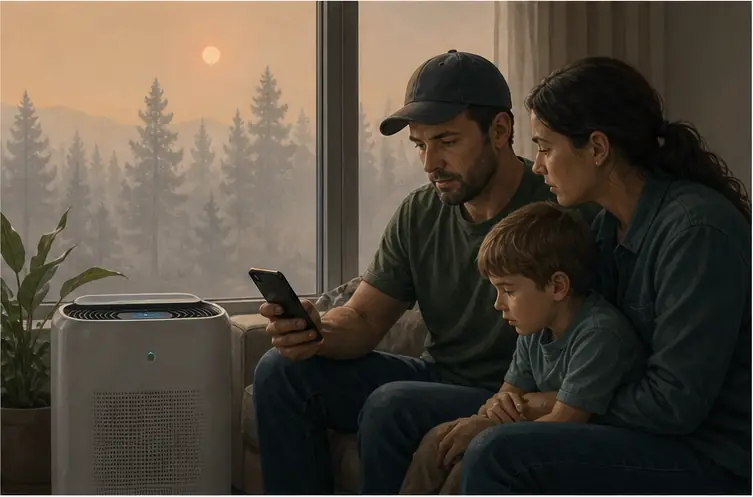
Wildfire smoke can affect health even when the air does not look or smell very smoky. The practical tool in Canada is the Air Quality Health Index, alongside local alerts.
Health Canada identifies fine particles as the main health concern in wildfire smoke. Conditions can change quickly, so check the local index and forecast rather than relying on a photo from another town.
Read the local air-quality message
The AQHI uses a 1 to 10+ scale and connects a local level to health advice. Look for special air-quality statements too. The right response depends on the location, the forecast, your symptoms and personal health factors.
- Check the AQHI and any special statement for your community.
- Reduce prolonged outdoor exercise when smoke is affecting air quality.
- Keep doors and windows closed when indoor air can remain cool and clean.
- Use a portable air purifier or seek a cleaner-air space when appropriate.
Who needs extra care
Children, older people, pregnant people, people with heart or lung conditions and people who work outdoors can be more affected. In heavy smoke, everyone should listen to symptoms and reduce exposure.
Smoke plus heat: choose the safer option
Closing windows can help with smoke but may make a home too hot. If you cannot maintain clean, cool air indoors, find information about local cooling or cleaner-air spaces. This trade-off is why local guidance matters.
When to seek help
Shortness of breath, chest pain, severe cough, wheezing, dizziness or an asthma attack require medical advice; call emergency services for a medical emergency.
Frequently asked questions
Can smoke be harmful if I cannot smell it?
Yes. Fine particles are not visible and may still affect air quality.
Is a mask always the main solution?
Reducing exposure and following local air-quality guidance come first; a well-fitted respirator may help when outdoor exposure cannot be avoided.
Official source
See Health Canada’s wildfire-smoke guidance.
Adapt the guidance to your situation
Health and weather advice depends on location, time, exposure and the individual. Check the latest official map and notice before changing travel or treatment. Children, older adults, pregnant people and those with chronic conditions may need additional caution.
- Prepare medication, water, a charged phone and a safe location.
- Follow local instructions rather than an undated viral post.
- Do not use a device or product contrary to its instructions.
- Seek medical advice for persistent symptoms, major exposure or a vulnerable person.
- Call emergency services for severe symptoms or immediate danger.
Read a warning correctly
The level, duration and area matter more than a dramatic word in a headline. A warning may be extended, moved or lifted. Record the consultation time and return to the responsible authority before an important decision.
What this article cannot replace
General information helps people prepare and recognize risks; it is not an individual diagnosis. Do not delay necessary care because a symptom resembles an example found online.
When conditions can change during the same day
Wildfire smoke does not remain uniform: wind direction, fire activity and local geography can make air quality improve or deteriorate within hours. Check the current AQHI before outdoor activity and again if the sky, smell or official alert changes. People with symptoms or higher health risks should follow medical advice and local public-health guidance. An ordinary face covering is not a substitute for clean indoor air or a properly fitted respirator when authorities recommend one.