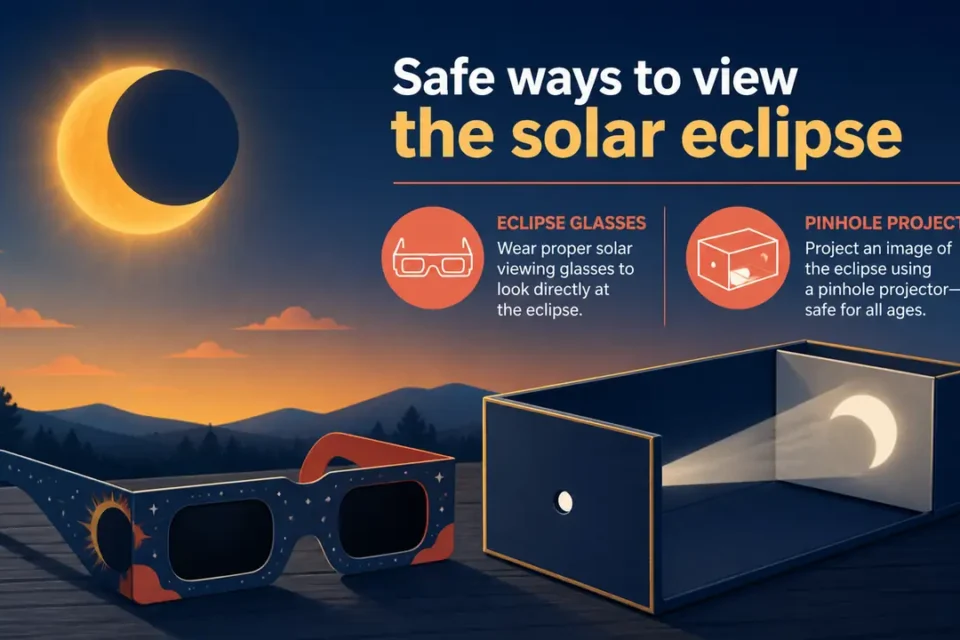
How can you check eclipse glasses before the August 12, 2026 solar eclipse? The question is surging as a total eclipse approaches Iceland and northern Spain, with a partial eclipse visible across much of Europe. Very dark lenses, ordinary sunglasses and homemade filters are not enough: direct viewing requires a solar viewer designed for the purpose.
What protection should you look for?
NASA says safe solar viewers should comply with the ISO 12312-2 international standard. That marking is a useful first check, but printed words alone do not prove a product came from a reliable source. Use an identifiable supplier and guidance from recognised astronomy organisations.
How to inspect eclipse glasses
- Examine both filters in normal light.
- Reject any pair that is scratched, punctured, peeling or creased through the filter.
- Read the manufacturer’s instructions.
- Put the viewer on before looking toward the Sun.
- Turn away before removing it.
Through a suitable filter, the everyday surroundings should look extremely dark. That observation does not replace trustworthy sourcing and correct use.
Are normal sunglasses enough?
No. Even very dark or stacked sunglasses do not filter sunlight like a specialist solar viewer. Photographic film, CDs, packaging, smoked glass and other improvised materials should not be used.
Can eclipse glasses be used with binoculars or a telescope?
Not simply by wearing them at the eyepiece. NASA warns that concentrated sunlight from a camera lens, binoculars or a telescope can burn through the filter. Optical equipment needs a suitable solar filter fitted to the front, following its manufacturer’s instructions.
What if you cannot find trustworthy glasses?
Use an indirect method such as a correctly made pinhole projector. You look at the Sun’s projected image, never through the hole. An official livestream is another eye-safe way to follow the event.
Do the glasses ever come off?
Only observers inside the path of totality may remove protection during the brief total phase, and only when the bright face of the Sun is completely covered. Anyone watching a partial eclipse must keep proper protection on throughout. Check your exact location with an authoritative eclipse map rather than assuming nearby conditions are identical.
Final checklist
- intact viewers from a traceable source;
- children supervised continuously;
- no optical equipment without a dedicated front-mounted solar filter;
- an indirect viewing option if anything is uncertain;
- heat and hydration precautions for outdoor viewing.
Bottom line
Do not shop only for lenses that look “very black.” Use a genuine solar viewer, inspect it and follow its instructions. If there is doubt, switch to projection or an official broadcast. Primary source: NASA.
Related question: Where can the August 12 eclipse be seen safely?
Adapt the guidance to your situation
Health and weather advice depends on location, time, exposure and the individual. Check the latest official map and notice before changing travel or treatment. Children, older adults, pregnant people and those with chronic conditions may need additional caution.
- Prepare medication, water, a charged phone and a safe location.
- Follow local instructions rather than an undated viral post.
- Do not use a device or product contrary to its instructions.
- Seek medical advice for persistent symptoms, major exposure or a vulnerable person.
- Call emergency services for severe symptoms or immediate danger.
Read a warning correctly
The level, duration and area matter more than a dramatic word in a headline. A warning may be extended, moved or lifted. Record the consultation time and return to the responsible authority before an important decision.
What this article cannot replace
General information helps people prepare and recognize risks; it is not an individual diagnosis. Do not delay necessary care because a symptom resembles an example found online.