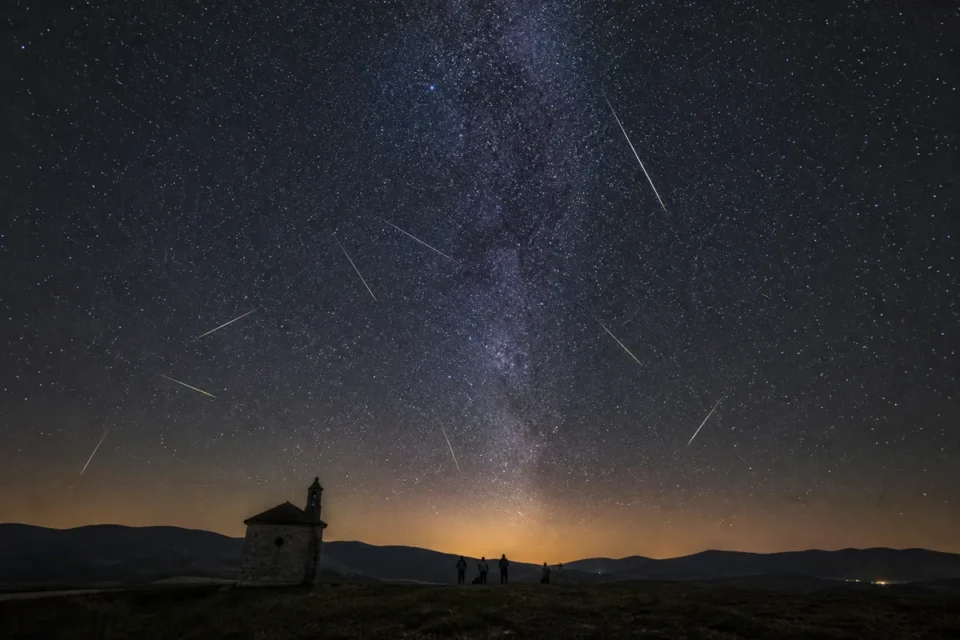
The 2026 Perseid meteor shower reaches its peak overnight on August 12–13. This annual display has especially favorable conditions because the maximum coincides with a new Moon, keeping natural skyglow low. You do not need a telescope. A dark location, a broad view of the sky and enough time are the most useful ingredients.
The shower is active from July 17 to August 24. The Royal Observatory Greenwich lists a theoretical peak rate of up to 150 meteors per hour. That is an ideal-sky figure, not a promise for every observer. Cloud, street lighting, haze, nearby buildings and the height of the radiant can reduce the number you actually see.
What time should you watch the Perseids?
The main viewing window is the night of Wednesday August 12 into Thursday August 13. Start once the sky is fully dark and, if possible, continue after midnight until before dawn. The radiant in Perseus rises higher as the night progresses. If cloud blocks the peak, the neighboring nights can still produce meteors.
You do not have to stare directly at Perseus. Meteors can cross a wide area of sky. Face the darkest, most open direction available and keep direct lights outside your field of view. A wide naked-eye view works better than magnification.
How to improve your chances
- Check the local cloud forecast before travelling.
- Choose a safe, permitted site away from direct lighting.
- Allow at least twenty minutes for your eyes to adapt.
- Turn off your phone screen or use a very dim red filter.
- Use a reclining chair or blanket so you can watch comfortably.
- Stay for at least thirty to sixty minutes because activity is uneven.
What causes the Perseids?
Earth passes through debris left by comet 109P/Swift-Tuttle. Tiny particles enter the atmosphere at high speed and create glowing trails as they heat the air around them. The shower is named after its apparent radiant in the constellation Perseus; the particles are not travelling from the stars in that constellation.
Can a phone photograph the shower?
A recent phone may capture brighter meteors when mounted on a stable tripod with night or manual mode enabled. Turn off the flash, avoid digital zoom and use a timer. Results are unpredictable: one exposure may record nothing while another catches a bright streak. Watching with your own eyes should remain the priority.
Frequently asked questions
Are the Perseids dangerous?
No. The visible particles are generally tiny and burn up high in the atmosphere.
Do you need special glasses?
No. Unlike a solar eclipse, a meteor shower is safe to watch directly. Eclipse glasses would make the night sky almost completely invisible.
What if the sky is cloudy?
Try a nearby night. Perseid activity continues beyond August 13, although the average rate gradually falls after the peak.
Sources: Royal Observatory Greenwich and NASA.
How can you watch the August 12 solar eclipse safely?
What should you bring to a viewing site?
Even in August, a long stationary session can feel cold. Bring an extra layer, water and a charged phone for safety, but keep the screen dim while observing. Tell someone where you are going if the location is isolated, use an established path and never stop on a road or enter private land. Binoculars are optional for exploring the sky between meteors, but they narrow your view and are not useful for following the fast streaks themselves.