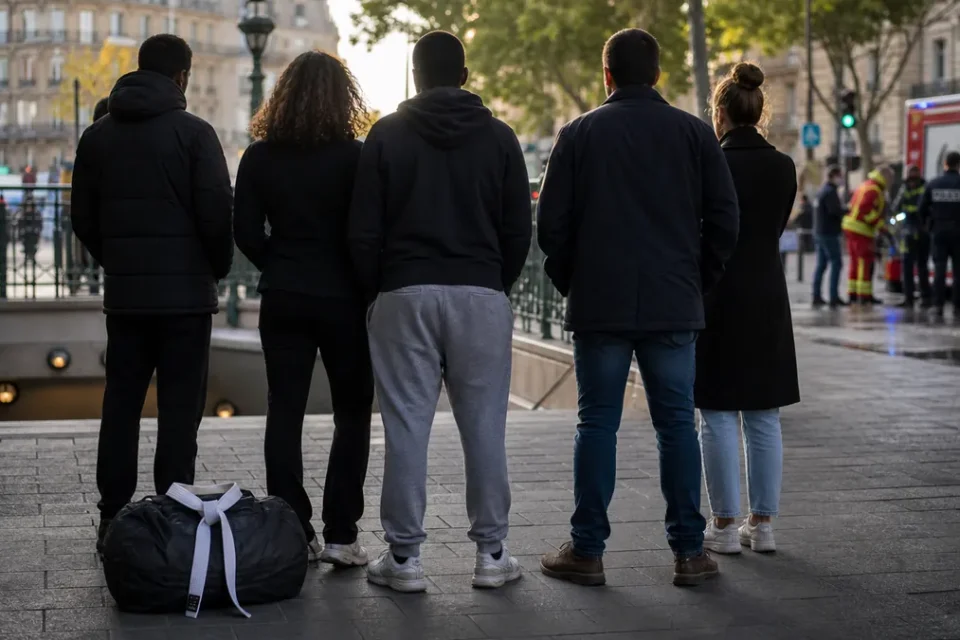
Mohamed-Ali Bouhadjar, a 26-year-old salesperson and judo practitioner, was among the citizens who helped stop the knife attack near Porte de Clichy on July 27, 2026. He did not act alone. His own account emphasizes the combined response of several bystanders, nearby restaurant workers and an off-duty police officer.
His testimony explains how a group formed within seconds and brought the assault to an end. It should not be read as a guide to confronting an armed person: such an intervention remains exceptionally dangerous.
What is known about Mohamed-Ali Bouhadjar?
Reuters and ANSA identify Bouhadjar as a 26-year-old salesperson who has practised judo for about 15 years. The available sources do not justify publishing private details about his home, employer or family.
He was near Porte de Clichy when he saw an armed man attacking women. He filmed part of the incident and posted the video on Snapchat before directly helping to restrain the suspect.
How does he describe the decisive moments?
Bouhadjar said he saw a woman stabbed in the back and shouted for nearby people to act together. A traveller carrying a suitcase used it to destabilise the armed man.
When the two knives fell to the ground, Bouhadjar used a judo leg sweep to bring the attacker down. Other people immediately joined him, keeping the man restrained and away from the weapons.
The sequence matters. He did not try to seize two knives on his own. The takedown came after distance had been created, the weapons were on the ground and several people were ready to help.
Why were there several heroes, not just one?
Published accounts also name Issa Besseka, an employee at a nearby restaurant, the passerby with the suitcase, other people who helped restrain the suspect and a restaurant worker who assisted an injured victim. An off-duty officer then made the arrest.
Focusing on one movement would miss the chain of solidarity. Some people raised the alarm, others separated the suspect from the weapons, restrained him, assisted the victims or contacted emergency services.
How might years of judo have helped?
A leg sweep is designed to disrupt another person’s balance. Long experience in judo can provide coordination, distance management and an ability to function under pressure. It does not make anyone safe against a knife.
Police and emergency guidance generally advises untrained witnesses to move to safety, warn others and call emergency services. The success of this exceptional group response should not encourage improvised confrontations.
What should a witness to an attack do?
- Move away and help others leave if a safe route is available.
- Call emergency services immediately and provide an exact location.
- Do not livestream police positions or tactical movements.
- Do not touch abandoned weapons and follow officers’ instructions.
- Assist victims only when the area is safe enough to do so.
Bouhadjar’s composure and the response of the other witnesses have been widely praised. Their story is ultimately one of spontaneous coordination among strangers when every second mattered.
Sources: Reuters via The Guardian and ANSA.